Super Mario Rpg Legend of the Seven Stars Box Art
| Super Mario RPG: Legend of the 7 Stars | |
|---|---|
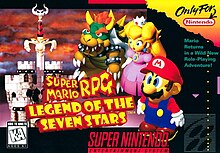 North American box art, depicting (from left to right) Exor, Bowser, Princess Toadstool, and Mario | |
| Developer(s) | Square |
| Publisher(south) | Nintendo |
| Manager(s) |
|
| Producer(southward) | Shigeru Miyamoto |
| Developer(s) | Fumiaki Fukaya |
| Artist(due south) |
|
| Writer(south) |
|
| Composer(s) | Yoko Shimomura |
| Series | Mario |
| Platform(due south) | Super Nintendo Entertainment Organization |
| Release |
|
| Genre(due south) | Role-playing |
| Mode(s) | Single-role player |
Super Mario RPG: Legend of the Seven Stars [a] is a role-playing video game developed by Foursquare and published past Nintendo for the Super Nintendo Entertainment System in 1996.[b] Information technology was the final Mario game published for the SNES. The game was directed by Chihiro Fujioka and Yoshihiko Maekawa, produced past Mario creator Shigeru Miyamoto, and scored by Yoko Shimomura.
Super Mario RPG 's story focuses on Mario and his friends every bit they seek to defeat Smithy, who has crashed into their world and stolen the seven star pieces of Star Route. Super Mario RPG is the beginning RPG in the Mario franchise, drawing from major elements of Foursquare's RPG franchises such as Final Fantasy. The main form of fighting enemies is plow-based combat with a party of upwardly to three characters. It is too the starting time game in the Mario franchise to take gameplay within an isometric 3D environment, allowing for a new variety of the exploration and platforming elements reminiscent of the Super Mario series.
Super Mario RPG was critically acclaimed, and especially praised for its humor and 3D-rendered graphics. Information technology was the inspiration for Nintendo's other role-playing series, Newspaper Mario and Mario & Luigi, and both are spiritual successors which retain some gameplay elements. Super Mario RPG was released on the Wii Virtual Console service in 2008, marking its debut in Europe and Commonwealth of australia, and after for the Wii U's Virtual Console in 2016. Information technology was as well included with the Super NES Classic Edition in 2017.
Gameplay [edit]
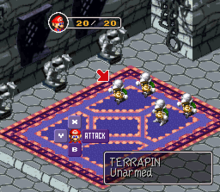
Mario in a battle against enemy Terrapins in the Bowser's Go along level
Super Mario RPG contains token similarities to other Square-developed video games, such equally the Final Fantasy serial, along with a story and gameplay based on the Super Mario Bros. series of platform games.[1] Like nearly traditional JRPGs, the ii main sections of the game are adventuring and turn-based battle sequences. Much of Super Mario RPG 's gameplay is outside monster battles and plays like an isometric 3D platformer, in which traditional Mario elements such as punching floating question blocks from below are prominent. There are no random encounters and as such enemies are visible in the field; a battle ensues only if Mario comes in contact with one. This allows the role player to evade unnecessary battles.[2]
The histrion's party initially begins with but Mario and grows to five characters. Mario and up to two other members participate in battles, who can exist swapped in and out while the player explores the overworld. Each of the five characters has a unique gear up of attacks and techniques. For case, Princess Toadstool's abilities are primarily healing techniques, whereas Geno and Bowser accept offensive attacks that deal high amounts of harm. The combat is based on a traditional turn-based battle system with the addition of action commands that amplify a move'due south furnishings. The player starts each plough by choosing to attack, defend, run, use an item, or perform magic from the gainsay bill of fare.[3] The activity command consists of timed button presses during an assault, special movement, defense force, or detail usage, which became a mainstay of later Mario RPGs.[2]
Plot [edit]
Characters and setting [edit]
The game globe is set in a geographically diverse country, which includes mountains, forests, and bodies of water. Each region has distinct characteristics held by its inhabitants; Mushroom Kingdom is inhabited by Toads, Moleville is inhabited by moles, Monstro Town is populated past reformed monsters, Yo'ster Isle is where Yoshi and his eponymous species reside, and Nimbus Land is an area inhabited by cloud people. Bowser's Castle is another prominent location in the game, as information technology holds the portal to the main adversary's homeworld.
Equally in near Super Mario games, the main protagonist is Mario, whose initial goal is to rescue Princess Toadstool from Bowser. However, the story takes on an unusual and very important twist. Soon afterwards the start of his journeying, the Smithy Gang invades the world. While attempting to stop the group, Mario is joined by Mallow, a cloud boy who thinks he is a tadpole; Geno, a doll possessed by a angelic spirit from the Star Route; Bowser, whose armies have deserted him out of fearfulness of the Smithy Gang; and Princess Toadstool, who was lost in the turmoil that occurred when the Smithy Gang arrived. The Smithy Gang is led by Smithy, a robotic blacksmith from an alternate dimension with aspirations of world domination.[4]
Story [edit]
Mario sets out to rescue Princess Toadstool, infiltrating the castle to which she has been taken and challenging kidnapper Male monarch Bowser.[two] During the battle, a giant living sword named Exor falls from the heaven, breaks through the Star Route (a pathway that helps grant people'due south wishes), and crashes into Bowser's castle,[2] sending Mario, Princess Toadstool, and Bowser flight in different directions, likewise equally scattering the vii-star fragments. Mario lands back at his pad and meets upwards with Toad, who tells him he has to rescue Toadstool. Mario returns to Bowser'southward castle, merely Exor destroys the bridge, preventing him from entering.[5] Mario makes his fashion to the Mushroom Kingdom, where Mario encounters a "tadpole" named Mallow who has set out to retrieve a frog coin taken by the local thief Croco.[6] After Mario helps him recollect the frog coin, they return to the Mushroom Kingdom to find that it is overrun by the Smithy Gang, followers of the evil robotic blacksmith rex named Smithy. Mario and Mallow enter the castle to defeat gang boss Mack,[seven] and later find a mysterious Star Slice. Mallow accompanies Mario to Tadpole Pond and then they can become advice from Frogfucius, Mallow'southward granddaddy. He reveals that Mallow is not really a tadpole, and says Mallow should join Mario on a quest to find the 7 Star Pieces every bit well as Mallow's real parents.
The duo travel to Rose Boondocks where they run into a star spirit who has blithe and taken command of a wooden doll named Geno. After battling the bow-like creature Bowyer, who is immobilizing residents of Rose Town with his arrows, they call back another Star Piece. Geno joins Mario and reveals to him the Star Piece is a part of the shattered Star Road, where he normally resides. Geno has been tasked with repairing Star Road and defeating Smithy, and so that the earth's wishes may again be heard.[viii] The trio somewhen caput to Booster Tower, the abode of the eccentric amusement-venue owner, Booster, where they see Bowser, whose minions take all deserted him. Bowser reluctantly asks Mario to help him to reclaim his castle; Mario agrees, allowing Bowser to save face by pretending he is joining the Koopa Troop, and Bowser joins the political party. The new team intercepts Princess Toadstool just before she is forcibly married to Booster, but it turns out that the nuptials wasn't real; Booster, having no idea what a matrimony actually is, only thought it was a fun political party and abruptly returns dwelling after devouring the cake.[9]
Subsequently her rescue, the princess returns home to Mushroom Kingdom only to and then decide to join the party while her grandmother takes her place in disguise.[10] After gathering five star pieces, they search Nimbus Land. A statue maker informs them that Valentina has the rulers of Nimbus Land beingness held captive, and her sidekick Dullard is impersonating the prince. Dodo would make Valentina his queen. The statue maker recognizes Mallow as the true prince, then disguises Mario every bit a statue to infiltrate the castle. There they defeat Valentina and Dodo. The newly liberated king and queen, Mallow's parents, inform the group that they saw a star fall into the nearby volcano.
After traveling to Barrel Volcano to obtain the sixth Star Slice, Mario's political party learns that the final piece must be held by Smithy in Bowser's castle.[11] They battle their manner through the assembled enemies to enter the castle, where they discover that Exor is actually a gateway to Smithy's factory, the identify where Smithy mass-produces his army.[12] Mario and company cantankerous over, find the heart of the factory, and defeat Smithy, thereby stopping his ground forces creation and causing Exor to disappear. The nerveless Star Pieces are used to repair the Star Route, Geno returns to the Star Road, Bowser rebuilds his castle with his newly reformed regular army, Mallow regains his rightful title as prince of Nimbus Country, and Mario and Princess Toadstool render to the Mushroom Kingdom to celebrate their victory.[thirteen]
Evolution [edit]
According to Yoshio Hongo of Nintendo, Super Mario RPG came out of Mr. Miyamoto's desire to make a RPG game using Mario, plus Square's desire to develop an RPG that could do meliorate outside of Nihon than their previous titles.[14] Evolution began in early on 1994 after a business coming together between Nintendo and Square. The first phase was spent on deciding a basic organization, while the isometric view was chosen to aid bring the globe to life. To aid the game fit with the Mario serial, it was fabricated to exist more action- and movement-focused compared to Square'due south other RPGs. Evolution began in earnest during the second quarter of 1995, when the programming, story events, and graphics data were existence implemented.[15] [xvi]
The game was officially unveiled by both Mario creator and producer Shigeru Miyamoto and co-director Chihiro Fujioka at the 1995 V-Jump Festival event in Nihon. Miyamoto led teams at Nintendo and Square, who spent over a year developing the graphics.[17] The story takes place in a newly rendered Mushroom Kingdom based on the Super Mario Bros. series. Square reported that the game was virtually 70% complete in October 1995. The developers created the interior elements such equally columns, stairways, and exterior elements with advanced reckoner modeling techniques. Special lighting effects were used to create shadows and reflections that were meant to amend the 3D elements.[18] [19] Shinya Takahashi, who would afterwards become head of Nintendo SPD and Nintendo EPD, designed the game's CG models.[xx] With guidance from Miyamoto, Square adult the game, combining part-playing aspects of previous Square games similar Final Fantasy Six with the platforming elements of Nintendo's games. Square's Last Fantasy serial was the model for the battle sequences, while the tradition of Super Mario Bros. games demanded a lot of action. Mario's power to jog in 8 directions and jump up or down in a 3–quarter perspective gave him a (comparatively) large range of motion. At 70% completion, the mix of adventure and action gameplay elements placed it in a category closer to The Fable of Zelda: A Link to the Past.[19]
When Nintendo of America received a 60% complete version in November, the staff were surprised at the inclusion of an RPG battle system. The battle screens, using pre-rendered sprites as in the rest of the game, included assail animations of equipped weapons.[21] In December, farther development and improvements to the gameplay delayed the translation of the game.[22] For example, the Chancellor, who was named the Mushroom Retainer in Japan,[nineteen] was chosen the "Minister" in N America.[22] Plans connected through February for the North American version,[22] irresolute the release date forecast from winter to jump.[19] [23] [24]
The game's soundtrack was composed by Yoko Shimomura, who incorporated arrangements by Koji Kondo from Super Mario Bros., and three tracks by Nobuo Uematsu from Final Fantasy 4. She regards the Super Mario RPG score as one of the turning points in her career as a composer.[25] The music from the game was released as a 2-disc soundtrack album in Japan past NTT Publishing on March 25, 1996, titled Super Mario RPG Original Sound Version.[26]
Super Mario RPG: Legend of the Seven Stars is i of merely vii SNES games released outside Japan to use the Nintendo SA-1 chip. Compared with standard SNES games, the additional microprocessor allows these features: college clock speeds; faster access to the random-admission memory (RAM); greater memory mapping capabilities, information storage, and pinch; new directly memory access (DMA) modes, such as bitmap to flake plane transfer; and built-in CIC lockout for piracy protection and regional marketing control.[27] It was not released in the PAL region; Nintendo representatives cited the need to optimize the game for PAL televisions and translate it into multiple languages.[14]
Release [edit]
Super Mario RPG became the terminal Super NES game released by Square in America, with Treasure of the Rudras and Treasure Hunter One thousand as the last games released in Japan.[28]
Super Mario RPG was released on Virtual Console for Wii in Japan on June 24, 2008.[29] It was released for the first time in Europe and Australia on August 22, 2008 on Virtual Console for Wii, equally office of the tertiary Hanabi Festival[30] [31] (a period in which several games not previously available in Europe are released on the Wii'southward Virtual Panel).[32] It was released on Virtual Console for Wii in North America on September ane, 2008, with the distinction of being the 250th Virtual Console game released in that region.[33] Super Mario RPG was released on Virtual Panel for Wii U in Nihon on August five, 2015,[34] in Europe and Australia on December 24, 2015, and in Northward America on June 30, 2016.[35] [36] [37] Information technology was also packed into the Super NES Classic Edition in 2017.[38]
Reception [edit]
Japanese audiences received Super Mario RPG well with 1.47 1000000 copies sold, making it the third highest-selling game in Japan in 1996.[56] Its sales in the U.s.a. surpassed Nintendo'due south expectations. For the game's release in the middle of May 1996, the company shipped 300,000 units to retailers; Nintendo estimated sell-through of more than 200,000 units within one month on shelves. A visitor representative said that "the championship is on rails to easily exceed our 500,000 target, and it may hands become a ane million seller past the stop of this calendar yr".[57] Past August 24, it had been the most-rented game in the United States for 14 weeks straight.[58] Information technology went on to exist the 6th best-selling video game of 1996 in the Us.[59]
Super Mario RPG received positive reviews. Though various aspects of Super Mario RPG received mixed reviews, it garnered praise for its graphics and for humor in detail. Nintendo Power 'southward review commented that the "excellent" 3D graphics helped the game appeal to a much wider audition than most traditional RPGs. In March 1997, Nintendo Power nominated the game for several awards, including "Best Graphics", in a thespian's choice contest,[60] though Super Mario 64 won "Best Graphics".[61] Electronic Gaming Monthly praised the graphics, stating that they are "the best seen on the Super NES".[42] Scary Larry of GamePro gave the game a perfect five/5 in all four categories (graphics, audio, control, and fun factor), and praised the rendered enemies, cine, and spell animations.[62]
1UP.com stated that the graphic element is "strong enough to resemble a Mario title but still retains the role-playing theme at the same time",[xl] and Electronic Gaming Monthly commented that the visuals are "typical of Nintendo, using clean and colorful graphics along with nice animation".[42] RPGamer editor Derek Cavin chosen the backgrounds "beautiful" and stated that they "perfectly bring the Mushroom Kingdom and surrounding areas into 3D".[52] Skyler Miller from Allgame stated that the graphics are "admittedly outstanding, with colorful, 3D rendered visuals that one time seemed impossible on the Super NES. This is definitely the loftier watermark for 3D graphics on any sixteen-bit system". The editor also called the music "quite extraordinary" and that the songs "lucifer the mood of the surrounding environment".[41] In the Virtual Console re-release, IGN's Lucas Thomas'south review of Super Mario RPG stated that the game's experience "completes itself with a compelling story, a humorous mental attitude and a diverseness of interspersed mini-games that intermission up the adventuring activity". The publication also stated that the soundtrack is "spectacular and a joy to heed to" and the graphics "took full advantage of the system's 16-flake technology and looks swell".[2]
Cavin said that near of the battle system mechanics "aren't very original" and as well criticized the "lack of a unified storyline".[52] In contrast, a reviewer for Next Generation found that the battle system refreshingly differed from tradition, and was pleased that "the elements that stand up out from the traditional formula are those that brand this a recognizable Mario game." He wrote that the gameplay was circuitous plenty to challenge even veteran RPG gamers, yet uncomplicated enough to non amerce newcomers to the genre.[50] Scary Larry similarly said the game "should please diehard RPG fans also every bit novice players", as it is genuinely tough and offers considerable replay value in the class of sidequests and bonus features such as Toadofsky'southward music levels. He also found Squaresoft's signature humour and puzzle-solving to be as exceptional as usual.[62] Miller commented that subsequently engaging in many battles, "the battle music becomes monotonous" and that after the game is browbeaten, "There aren't any surprises to be discovered the second time around".[41] While 1UP.com stated that "The characters seem also childish for older gamers",[63] Next Generation said the game is "held together by the strength of its characters and well-adult world."[50]
Electronic Gaming Monthly editors named Super Mario RPG a runner-upwards for both Super NES Game of the Yr (backside Tetris Set on) and Role-Playing Game of the Yr (behind Blood Omen: Legacy of Kain).[64] In 2018, Complex ranked the game eighth on their "The Best Super Nintendo Games of All Time."[65]
Legacy [edit]
Super Mario RPG received positive reviews and appeared on reader-selected "best game of all time" lists, such every bit 30th at IGN,[66] and critic-selected "best games of all time" lists, such equally 26th in Electronic Gaming Monthly.[67]
Super Mario RPG does non have a direct sequel but it established conventions for its thematic and spiritual successors, the Newspaper Mario series and Mario & Luigi series. Nintendo originally appear a game titled Super Mario RPG 2 for 64DD, which was renamed to Paper Mario before its release on the Nintendo 64.[68] [69] Themes shared with the original include the utilise of Blossom Points as a shared political party resource instead of each character having their own pool of Magic Points, timed action commands during battles, and the collection of seven stars.
Both Fujioka and Maekawa went on to work at AlphaDream, having a hands-on interest with almost every single entry in the Mario & Luigi series. Yoko Shimomura returned as well, having composed the soundtrack for every title. Mario & Luigi: Superstar Saga features a cameo of Geno in one of the minigames, and the cease credits mention Foursquare Enix as the copyright holder of the character;[70] this cameo was removed for the game's Nintendo 3DS remake. Afterwards accumulating a massive debt past March 2018, AlphaDream would file for bankruptcy in October 2019, leaving the future of the Mario & Luigi series in limbo.
Various locations and characters from the game announced in the children'southward book Mario and the Incredible Rescue released by Scholastic in 2006.[71] Though his only starring role in a video game was in Super Mario RPG, Masahiro Sakurai added the fan-favorite character Geno as a Mii Fighter costume to the crossover fighting game series Super Nail Bros. as paid DLC, attributing his inclusion to his matching arm cannon.[72] [73] Super Mario RPG is among the 21 preinstalled games on the Super NES Classic Edition in all regions, released in September 2017.[74]
Notes [edit]
- ^ Known in Nippon as Super Mario RPG (Japanese: スーパーマリオRPG)
- ^ The game was originally not released in PAL regions such as Europe.
References [edit]
- ^ Pelland, Scott; Miller, Kent; Munson, Terry; Shinoda, Paul (Oct 1996). "Epic Centre". Nintendo Power. Grand. Arakawa, Nintendo of America, Inc. (89): threescore.
- ^ a b c d e f Thomas, Lucas (September 2, 2008). "Super Mario RPG: Legend of the Seven Stars Review". IGN. Archived from the original on September 3, 2008. Retrieved January vii, 2010.
- ^ Ogasawara, Nob (April 1996). "Super Mario RPG". GamePro. No. 91. IDG. p. 47.
- ^ Smithy: "Hurrumph! Ameliorate still... Why don't You requite me YOUR stars. Why, so I could easily conquer this world! And then we could go rid of all wishes, and create a globe filled with...WEAPONS!!" Foursquare (1996). Super Mario RPG (Super Nintendo Amusement System). Square.
- ^ Foursquare (1996). Super Mario RPG: Legend of the Seven Stars (Super Nintendo Entertainment System). Nintendo.
Chancellor: It volition be upwardly to you to enter the go along and rescue Princess Toadstool! / Mario...her life is in your easily. Please, salve our dear Princess! / Mario! Forgive me. But I can't stop worrying about the Princess...
- ^ Square (1996). Super Mario RPG: Fable of the Seven Stars (Super Nintendo Amusement Organisation). Nintendo.
Mallow: Oh, no! That REPTILE stole my Grandpa's coin! / My Grandpa asked me to buy some things for him here. When I walked into town, that croc stopped me! Oh yeah! He took it from me! He stole my coin! I chased him, but he'due south style also fast... / I'chiliad Mallow from Tadpole Swimming. I'm a frog, but tin you believe information technology? I tin't jump. Embarrassing huh?
- ^ Square (1996). Super Mario RPG: Legend of the Seven Stars (Super Nintendo Entertainment System). Nintendo.
Mack: Listen up, gang! These guys are gonna put a terminate to OUR political party! Are we happy almost this?!
- ^ Square (1996). Super Mario RPG: Legend of the Vii Stars (Super Nintendo Amusement System). Nintendo.
Geno: Just Mario and I must leave at present to detect... the missing Star Pieces... / Gaz: Star Pieces? You mean like shooting stars? What for? / Geno: No 1'southward wishes will come true until the Star Pieces are found and the Star Road repaired. Which is why I have chosen to bring together these ii in gild to find the missing Star Pieces.
- ^ Foursquare (1996). Super Mario RPG: Legend of the 7 Stars (Super Nintendo Entertainment System). Nintendo.
Booster: I'one thousand Booster and this is my famous tower of entertainment. Normally I welcome visitors to play with me and my Snifits. Nevertheless, a girl fell out of the sky and into my lap, recently. Since then, I've been decorated keeping her happy and entertained. I no longer have the time to play. And so delight savour yourself... at your ain risk, that is! / My helpmate-to-be is chanting, "MARIOHELPMEMARIOHELPME". Is she showing her happiness?
- ^ Square (1996). Super Mario RPG: Legend of the Vii Stars (Super Nintendo Entertainment System). Nintendo.
Toadstool: Finally...let'southward get dorsum. / I'chiliad finally home! / Nosotros need to go and find those Star Pieces, At present! / Chancellor: Princess! Yous Tin can'T be serious! You're Not thinking of joining them, ARE Y'all? This is sheer madness... You lot're a Princess! What will people say?! / Toadstool: I don't care! Things seem so hopeless right now... / Mario! Please, Mario! Have me forth with you, please! / So...allow's get find us a star! Hmmm... But I wonder where it could be... I accept admittedly no idea! Do yous? / Okay then! Let's do it!
- ^ Square (1996). Super Mario RPG: Legend of the Seven Stars (Super Nintendo Entertainment Organization). Nintendo.
Queen Nimbus: The last star... Wait! The just place left to look is in Bowser'due south Keep!
- ^ Foursquare (1996). Super Mario RPG: Legend of the Seven Stars (Super Nintendo Amusement Organisation). Nintendo.
Clerk: Production is on schedule? This, despite the fact that Mack, Bowyer, Yaridovich, and the Axem Rangers were defeated. At this rate, Smithy volition accept a new army in no fourth dimension!
- ^ Square (1996). Super Mario RPG: Fable of the 7 Stars (Super Nintendo Entertainment Organization). Nintendo.
Smithy: NOOOOOOOOOOOO...!!! / Guooooooo!!!!! My b...body and caput are burning! It's non...possible...! I don't believe it...! I'm...finished...done for...! Guooooooooo...noooooo...! / Geno: Come on, Mario! Send the last one way up loftier!... Thanks, everyone! The Star Route is back to normal!
- ^ a b "Nintendo Ultra 64: The Launch of the Decade?". Maximum: The Video Game Magazine. Emap International Limited (2): 107–8. November 1995.
- ^ "Super Mario RPG – 1995 Developer Interviews". Shmuplations.
- ^ "Futurity Fantasies". GamePro. No. 87. IDG. Dec 1995. pp. 136–9.
- ^ Pelland, Scott; Miller, Kent; Munson, Terry; Shinoda, Paul (April 1996). "Ballsy Center". Nintendo Power. Nintendo (83): 56.
- ^ Pelland, Scott; Miller, Kent; Munson, Terry; Shinoda, Paul (October 1995). "Special Features". Nintendo Ability. Nintendo (77): 29.
- ^ a b c d Pelland, Scott; Miller, Kent; Munson, Terry; Shinoda, Paul (October 1995). "Mario plays a new role". Nintendo Power. M. Arakawa, Nintendo of America, Inc. (77): 26–29.
- ^ End credits: "C.G. Model Designer: Shinya Takahashi" Square (March 9, 1996). Super Mario RPG: Legend of the 7 Stars. Nintendo.
- ^ Pelland, Scott (November 1995). "Epic News". Nintendo Power (77): 51.
- ^ a b c Pelland, Scott (December 1995). "Ballsy News". Nintendo Power (77): 51.
- ^ Pelland, Scott (November 1995). "Release Forecast". Nintendo Power (77): 113.
- ^ Pelland, Scott (December 1995). "Release Forecast". Nintendo Ability (77): 113.
- ^ Shimomura, Yoko (October 1, 2009). "Interview with Yoko Shimomura (September 2009)". Square Enix Music Online, GameMusic.pl. Retrieved Baronial 9, 2011.
- ^ Thomas, Damian (March 23, 2001). "Super Mario RPG OSV". RPGFan. Retrieved August 9, 2011.
- ^ "Games - ZSNES Documentation". ZSNES. Retrieved March 24, 2013. "IGN Height 100 Games 2008". IGN. Archived from the original on November 10, 2008. Retrieved September 8, 2011.
- ^ Mackey, Bob (May 13, 2016). "How an Unexpected Pairing Gave Super Mario RPG a 20-Year Legacy". USgamer . Retrieved June ane, 2019.
- ^ "Japanese Virtual Console list - June 2008". nintendo.co.jp. Nintendo Nihon. May 30, 2008. Archived from the original on July 22, 2008. Retrieved January 31, 2021.
- ^ Anderson, Luke (August 26, 2008). "Super Mario RPG hits Europe VC". GameSpot . Retrieved June 28, 2017.
- ^ Vuckovic, Daniel (August 21, 2008). "Hanabi Festival returns - Super Mario RPG arrives in Australia". Vooks . Retrieved June 28, 2017.
- ^ White, Baton (August 22, 2008). "Hanabi Festival brings Super Mario RPG to Europe". Wiiloveit.com . Retrieved June 28, 2017.
- ^ "SMRPG arrives on the Wii Virtual Console for auction at 800 points". IGN. September 1, 2008. Archived from the original on September iii, 2008. Retrieved December 9, 2008.
- ^ "『スーパーマリオRPG』と『ダウンタウン熱血物語』がWii Uバーチャルコンソールで8月5日配信開始". Famitsu (in Japanese). July 29, 2015. Archived from the original on July 31, 2015. Retrieved Jan 31, 2021.
- ^ Dornbush, Jonathon (June 29, 2016). "Super Mario RPG Releasing for Wii U Virtual Console This Week". IGN . Retrieved June 28, 2017.
- ^ Skipper, Ben (December 21, 2015). "Super Mario RPG heading to Nintendo Wii U virtual console on Christmas Eve". International Concern Times. IBT Media. Retrieved December 21, 2015.
- ^ Wassenaar, Troy (December 23, 2015). "Aussie Nintendo Download Updates (24/12) - Holiday Special - eShop News from Vooks". Vooks . Retrieved June 28, 2017.
- ^ Orry, Tom; Cryer, Hirun (November 23, 2018). "SNES Classic Edition Black Friday Deals - How to Buy a SNES Classic? SNES Archetype Release Date, SNES Classic Reviews, What Games are Included?". USgamer. Gamer Network. Archived from the original on May 31, 2019. Retrieved Jan 31, 2021.
- ^ "Super Mario RPG: Legend of the Seven Stars Reviews". GameRankings. Archived from the original on Dec 9, 2019. Retrieved September 10, 2007.
- ^ a b "Super Mario RPG Review from SNES, Wii from 1UP.com". 1UP.com. Ziff Davis. Archived from the original on Apr 18, 2015. Retrieved Apr 24, 2015.
- ^ a b c Miller, Skyler. "Super Mario RPG: Legend of the Seven Stars - Review - allgame". AllGame. Archived from the original on December 11, 2014. Retrieved April 24, 2015.
- ^ a b c Baran, Andrew; Lefebvre, Mark; Desmond, Mike; Sushi X (July 1, 1996). "Super Mario RPG: Legend of the 7 Stars (EGM 82)". Electronic Gaming Monthly. Archived from the original on May fourteen, 2004. Retrieved Apr 24, 2015.
- ^ Whitehead, Dan (August 26, 2008). "Virtual Console Roundup Review". Eurogamer. Archived from the original on Feb 25, 2010. Retrieved August 30, 2021.
- ^ "スーパーマリオRPG [スーパーファミコン] / ファミ通.com". Famitsu . Retrieved June ane, 2019.
- ^ "Viewpoint". GameFan. Vol. 4, no. 5. May 1996. pp. 12–thirteen. Retrieved August 30, 2021.
- ^ "Legacy Review Athenaeum". Game Informer . Retrieved October iii, 2021.
- ^ Baggatta, Patrick; Chris (May 1996). "Super Mario RPG". Game Players. No. 84. pp. 56–57. Retrieved August 30, 2021.
- ^ René (July 1996). "Super Mario RPG". Mega Fun (in German). p. 74. Retrieved Baronial thirty, 2021.
- ^ "Mario RPG Review". Retrieved May 22, 2010.
- ^ a b c "Plumbing Depth". Next Generation. No. xviii. Imagine Media. June 1996. p. 126.
- ^ "At present Playing". Nintendo Power. Vol. 84. May 1996. pp. 94–97. Retrieved August 30, 2021.
- ^ a b c Cavin, Derek (March xiii, 2004). "Mario Gets HP". RPGamer. Archived from the original on September 30, 2007. Retrieved Feb 21, 2008.
- ^ Hansen, Sam (February 24, 2009). "Super Mario RPG: Fable of the Seven Stars". RPGFan. Archived from the original on February 28, 2009. Retrieved August 30, 2021.
- ^ Oxford, Nadia (January 23, 2019). "Super NES Retro Review: Super Mario RPG: Legend of the Seven Stars". USgamer . Retrieved Baronial thirty, 2021.
- ^ "Super Mario RPG". Video Games (in German language). July 1996. pp. 98–99. Retrieved August 30, 2021.
- ^ The Magic Box (The Webmaster) (October 31, 2006). "The Magic Box: Platinum Game Chart, Japanese Panel Games Sold Over One Million". The Magic Box: International Videogame News. The Magic Box. p. 1. Archived from the original on December 13, 2007. Retrieved Feb twenty, 2007.
- ^ Staff (June 20, 1996). "Us RPG Demand Surprises Nintendo". Side by side Generation. Archived from the original on June 6, 1997. Retrieved February 6, 2021.
- ^ Staff (August 24, 1996). "Mario RPG Tops Rentals Again". Next Generation. Archived from the original on April nineteen, 1997. Retrieved Feb 6, 2021.
- ^ Famighetti, Robert (1997). "Top-Selling Video Games, 1996". The World Almanac and Book of Facts 1998. Globe Almanac Books. p. 259. ISBN0886878217.
Source: The NPD TRSTS Video Game Tracking Service, The NPD Group, Inc., Port Washington, NY; ranked by units sold
- ^ Owsen, Dan; Pelland, Scott (March 1997). "1996 Nintendo Power Laurels Nominations". Nintendo Power (94): 76, 77, 79–82.
- ^ Pelland, Scott (May 1997). "1996 Nintendo Ability Awards Winners". Nintendo Power (96): 88, 89, 92, 93.
- ^ a b "Super Mario RPG: Fable of the 7 Stars". GamePro. No. 92. IDG. May 1996. pp. 84–85.
- ^ "Super Mario RPG: Fable of the 7 Stars Reviews". 1UP.com. May ix, 2004. Archived from the original on October xx, 2012. Retrieved August 7, 2011.
- ^ "The Best of '96". Electronic Gaming Monthly. No. 92. Ziff Davis. March 1997. pp. 86, 88.
- ^ Knight, Rich (April xxx, 2018). "The Best Super Nintendo Games of All Time". Complex . Retrieved February xvi, 2022.
- ^ "IGN Readers' Selection 2006 - The Acme 100 Games Ever". GameFAQs. IGN. October 5, 2006. p. ane. Archived from the original on March 17, 2012. Retrieved Feb 20, 2007.
- ^ "100 Best Games of All Time". Electronic Gaming Monthly. No. 100. Ziff Davis. November 1997. p. 141. Note: Contrary to the title, the intro to the article (on page 100) explicitly states that the list covers panel video games only, meaning PC games and arcade games were not eligible.
- ^ Kennedy, Sam (August 28, 1999). "First Impressions: Super Mario RPG 2". GameSpot . Retrieved September 4, 2007.
- ^ Ahmed, Shahed (May 19, 2000). "Super Mario RPG 2 Japanese Release Date". GameSpot . Retrieved September iv, 2007.
- ^ AlphaDream (November 17, 2003). Mario & Luigi: Superstar Saga (Game Male child Accelerate). Nintendo. Level/expanse: Little Fungitown / game credits.
- ^ W, Tracey (2006). Mario and the Incredible Rescue. Scholastic Corporation. ISBN0-439-84366-ix.
- ^ Sakurai, Masahiro (February 20, 2016). "Nintendo Dream". Nintendo Dream (Interview). Vol. 264. English translation.
- ^ McWhertor, Michael (December 17, 2020). "Boom Bros. Ultimate makes Geno a Mii Fighter, catastrophe the dream". Polygon . Retrieved December 18, 2020.
- ^ "Super NES Classic Edition". Nintendo of America, Inc. September 29, 2017.
External links [edit]
Source: https://en.wikipedia.org/wiki/Super_Mario_RPG
0 Response to "Super Mario Rpg Legend of the Seven Stars Box Art"
Post a Comment